 EN
EN 
Chicken vs. Zombies Review: demo, mechanics, and real-money play
Chicken vs. Zombies by InOut Games is a fast crash-slot hybrid where your bet rides a growing multiplier and you decide when to cash out before zombies catch the chicken. The theme blends arcade tension, instant decisions, and wallet-friendly stakes, so players can explore risk control, bankroll discipline, and mobile-friendly gameplay in one compact product. As of june 2026, interest spikes thanks to accessible demo play, straightforward rules, and real-money potential once you master timing and variance.
What Chicken vs. Zombies actually is
This is not a reel slot with paylines. Each round begins with a stake, the multiplier climbs in real time, and the run ends if the chicken is bitten. Your only job is to cash out in time. That single decision point creates clear risk profiles: earlier exits trade smaller wins for higher hit rate, later exits chase bigger payouts with increased crash probability. The result is easy onboarding plus genuine depth for strategy-minded players.

Key specs and who will enjoy it
RTP sits in the medium range for crash content, volatility feels controllable at low multipliers, and stake limits suit cautious newcomers and high-risk test runs alike. If you like short sessions, clean UX, and a fair chance to practice before depositing, this product fits. As with any real-money game, treat every session as entertainment, not income.
Core parameters and quick benchmarks
Chicken vs. Zombies packs the essentials players look for when they evaluate a new crash title: RTP transparency, flexible stakes, and a clear ceiling on max win. Understanding these numbers helps align expectations and build a realistic cashout model without illusions.
Below are practical values you will use when testing demo and planning your real-money approach. They guide baseline risk, average session length, and how aggressively you might target multipliers on different difficulty presets.
| Metric | Value |
|---|---|
| RTP | 95.5% |
| Stake range | 0.01 to 200 per round |
| Max single-round win | up to 20,000 |
| Difficulty presets | Easy, Medium, Hard, Hardcore |
Even small differences in target multiplier drastically change your hit rate, so lock a default cashout range and calibrate it in demo before you switch to real money. Keeping the same anchor range across sessions makes performance easier to track and avoids random overreach.
Demo mode: how to test mechanics properly
The demo is your sandbox for timing and nerves. It lets you explore the pace of the multiplier, compare difficulty presets, and rehearse cashout discipline without bankroll pressure. Treat demo as a structured rehearsal, not a joyride, and you will carry those habits into real-money sessions.
- Launch the game and start on Easy with the minimum stake equivalent.
- Play 20 to 30 quick runs targeting a modest cashout window like 1.4x to 1.8x.
- Record where you hesitated and where you cashed out early, then tighten your range.
- Test Medium for 10 runs, keeping the same range to compare crash frequency.
Your goal is muscle memory. When the multiplier hits your preset, click without hesitation. That reduces impulse errors, the biggest leak in crash games, and gives you a steady baseline to evaluate later adjustments.
Real-money play: safe onboarding and withdrawals
Once the demo feels natural, you can transition to real-money play with a capital-preserving plan. Think in sessions and limits, not in endless play, and define withdrawal habits before the first depsoit to avoid scope creep.
- Register, verify your account, and set a daily or session deposit limit.
- Start with your demo-tested cashout window and a fixed bet size for 30 to 50 runs.
- Use stop-loss at 3 to 5 base bets and a mirrored stop-win to force cooldowns.
- When ahead, withdraw a portion immediately, then continue on a smaller balance.
Keeping withdrawals regular builds a healthy loop. It also highlights how streaks affect mindset, which helps you stick to your plan on harder difficulty presets.
Difficulty and round pacing
Difficulty affects how quickly risk accumulates. Easy is forgiving and stretches time to decision, while Hardcore compresses everything, rewarding sharp timing but punishing hesitation. Think of it as shifting the curve of expected survival time against your target multiplier.
Difficulty levels vs risk-reward
Players often ask how to evolve from Easy to Medium and beyond without blowing up a session. The cleanest answer is to keep your cashout range modest when stepping up and only widen it after stable results at the new preset.
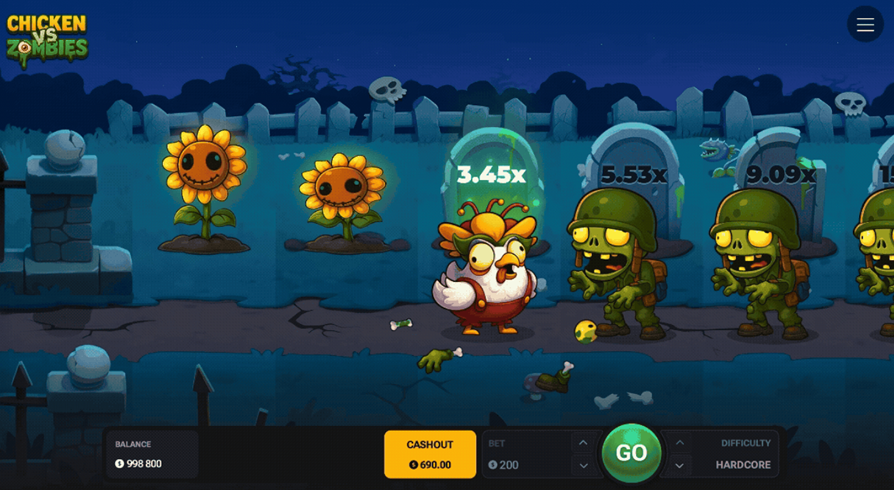
Use this matrix to map your preferred pace to round volatility and adjust goals accordingly. It anchors expectations before you raise stakes or targets.
| Preset | Crash frequency feel | Suggested target range | Who should use it |
|---|---|---|---|
| Easy | Low to moderate | 1.3x to 1.8x | Newcomers, bankroll testing |
| Medium | Moderate | 1.5x to 2.2x | Graduating players |
| Hard | Higher | 1.8x to 3.0x | Advanced timing |
| Hardcore | High | 2.0x to 5.0x | Risk seekers with strict control |
Advancing too fast creates fake confidence, especially after short hot streaks. Stay in one preset long enough to gather a meaningful sample before you widen the range or raise the base bet.
Bet sizing and payout math
Crash games reward discipline in stake sizing far more than sporadic high multipliers. A flat base bet across a cluster of runs normalizes variance and lets your cashout consistency do the heavy lifting. This consistency is boring on purpose, and boring is what protects bankrolls.
Bet sizes and example payouts
This table converts typical multipliers into concrete outcomes. Seeing exact numbers focuses your attention on stable targets rather than jackpot chasing, which is where most avoidable mistakes occur.
Concrete payouts at common multipliers show how small edges compound over a session. Use them to lock your baseline and only deviate when results justify it.
| Base bet | Cashout at 1.5x | Cashout at 2.0x | Cashout at 3.0x |
|---|---|---|---|
| 0.50 | 0.75 | 1.00 | 1.50 |
| 2.00 | 3.00 | 4.00 | 6.00 |
| 10.00 | 15.00 | 20.00 | 30.00 |
| 25.00 | 37.50 | 50.00 | 75.00 |
If you repeatedly miss your target due to hesitation, drop your target slightly and rebuild confidence. Most losses in crash titles are psychological, not mathematical.
Strategies that actually help
Theory means little if you cannot execute it under pressure. Keep tactics simple and automatable, with rules that survive fatigue and mood. Tie every tactic to your cashout anchor and your stop conditions.
- Micro-edge: 1.4x to 1.7x for many short wins that offset occasional early crashes.
- Ladder: three conservative runs at 1.5x, then a single probe at 2.5x to 3.0x, repeat.
- Time boxing: 15 to 25 minutes per session, then forced break, no exceptions.
- Loss brake: reduce stake by 50 percent after two consecutive crashes, recover slowly.
These are not promises of profit, they are guardrails for behavior. The best strategy is the one you can execute identically in demo and cash play without tilting.
Bonuses, wagering, and clean cashouts
Bonuses can stretch testing budgets but come with wagering, contribution rules, and max cashout clauses. If you want fast withdrawals, lean toward smaller match offers with light rollover instead of flashy high-percentage bundles that lock your balance for ages. For frictionless tranasction flow, keep documents ready for KYC.
Bonus types to watch in 2026
This breakdown prioritizes utility over hype. It aims to minimize rollover pain and avoid hidden caps that undermine smart play in a crash environment.
Each bonus type has a place, but heavy wagering on a volatile product can distort your decision making. Pick offers that align with your session length and risk tolerance.
| Bonus type | Typical wagering | Best use case | Notes |
|---|---|---|---|
| Small match 25-50 percent | 15x to 25x bonus | Stretching test budget | Safer rollover burden |
| Free spins conversion | 20x to 35x FS value | Side value, not core | Check conversion rate |
| Cashback 5-15 percent | 1x to 5x cashback | Tilt buffer | Simple terms, fast relief |
| Wager-free small credit | None | Clean trials | Often limited amount |
Always confirm game eligibility and max cashout caps before accepting any offer. If terms feel confusing, skip the bonus and keep withdrawals faster and cleaner.
Mobile play and UX details
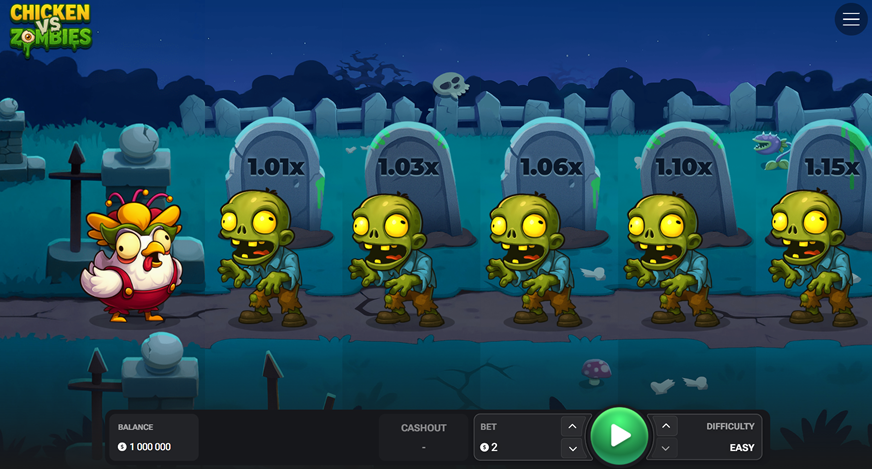
Mobile sessions benefit from bigger touch targets and consistent frame pacing. On iOS and Android, Chicken vs. Zombies loads quickly and the cashout button remains prominent, which matters when multipliers accelerate. A quiet environment helps you focus on timing and prevents accidental taps.
Mobile performance checklist
This checklist compresses device-level considerations into a simple go or no-go test. Run through it once in demo so real-money taps feel natural and reliable.
Comfortable ergonomics and stable network reduce input errors. If you notice lag or hesitations, drop difficulty and target a lower multiplier until conditions improve.
| Checkpoint | What to confirm | Action if not OK |
|---|---|---|
| Frame stability | Smooth climb, no stutter | Relaunch app, clear background apps |
| Touch response | Instant cashout on tap | Switch to Wi-Fi or wired |
| Button layout | No overlap or thumb stretch | Rotate device or adjust grip |
| Battery/heat | No throttling mid-session | Shorter sessions, lower brightness |
Treat mobile as a skill device. If performance dips, the safest play is to pause, not to push through degraded conditions.
Pros and cons for decision makers
Every product choice is a tradeoff. This one offers clarity, speed, and structured risk, with math that rewards consistent execution. If your preference is slow build-up and elaborate bonus features, a reel slot may fit better.
- Pros: fast rounds, simple learning curve, demo-first onboarding, clean multiplier targets.
- Cons: discipline dependent, streaky outcomes at higher presets, no reel-style feature variety.
If you like to tinker with risk settings without getting lost in menus, you will likely enjoy the loop. If you crave narrative and feature hunts, keep this as a side game for short bursts.
Common mistakes and how to avoid them
Players usually overestimate reaction time and underestimate tilt. Both issues fade when you adopt written rules and stick to them. Write your anchor range on a sticky note if that helps self-contorl.
- Chasing after two losses in a row.
- Randomly widening the target multiplier mid-session.
- Ignoring network stutters on mobile while playing Hardcore.
- Accepting heavy-wager bonuses that block withdrawals.
If any of these appear in your last session, step back to demo, reset targets, and rebuild confidence at lower stakes until execution looks clean again.
Final verdict
Chicken vs. Zombies nails the essentials of a modern crash experience: fast runs, readable risk, and a demo that genuinely prepares you for real-money play. Keep your target multiplier modest, schedule withdrawals, and choose bonus terms that don’t distort your decisions. With that discipline in place, this game becomes a sharp, repeatable loop you can enjoy on short breaks or structured evening sessions. As of june 2026, it is one of the cleaner ways to blend practice, timing, and real-cash stakes without a steep learning curve.
FAQ
How does the demo help before real-money play
What is a sensible first real-money setup
Can bonuses slow down withdrawals
What makes Chicken vs. Zombies different from reel slots
What target multiplier should I choose on Medium
Are withdrawals fast if I skip bonuses
Is Hardcore worth it for small bankrolls
Does InOut Games affect gameplay fairness
What if I tilt after two quick crashes